My Booking


 English (US)
 Spanish (ES)








Need help
finding deals?
Our travel experts are ready to help you find the perfect hotel or car rental.
Call 24/7: +1-216-302-2732 Exclusive Flight Deals
 Best Price Guaranteed
 24/7 Customer Support
Earn up to $50* in Gift Rewards after every flight booking



Our travelers speak from the heart, here's what they have to say.
 Customer Support


Last updated on Sunday 11/06/2026 at 05:00 AM, the fares mentioned above are for Round Trip flight tickets and inclusive of fuel surcharges, service fee and taxes. Based on historical data, these fares are subject to change without prior notice and cannot be guaranteed at the time of booking. Kindly go through our terms and conditions before booking.
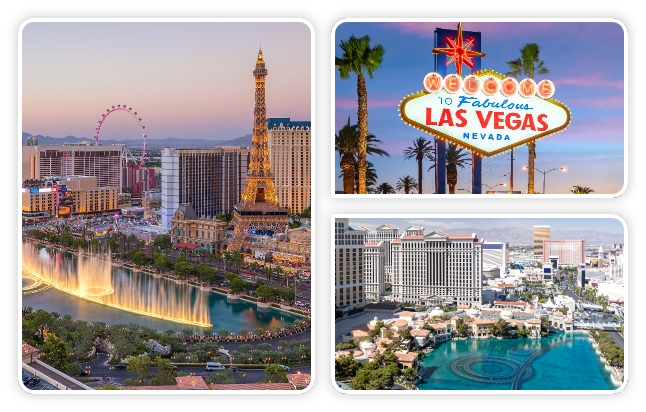
Flights to Las Vegas run cheaper than almost any other major US destination, and that comes down to volume. Harry Reid International handles roughly 400 to 500 departures a day, with Southwest, Spirit, Frontier and Allegiant all basing aircraft there. Competition on the big feeder routes keeps fares down for most of the year.
From Los Angeles the hop is barely an hour. From New York you are looking at closer to five and a half. Either way, what you pay depends far more on when you book and when you fly than on which airline you end up with.
Below you will find what a Las Vegas ticket costs month by month, which departure days come in lowest, how far ahead to book, and what to sort out before you go.
At Cheap Flights Fares, we make booking travel simple, flexible, and supported from start to finish.
Los Angeles is the cheapest way into Las Vegas, and the short West Coast routes as a group cost a fraction of the East Coast ones. Four airlines base aircraft at LAS and compete hard on those runs, which keeps the floor low most of the year. Live fares for every route below appear in the search at the top of this page.
 From
 Route
 Nonstop Airlines
 Fare Level
Flying from the East Coast, a connection through Denver or Phoenix is sometimes cheaper than the nonstop. It adds two to three hours, so it comes down to how you value the afternoon.

The second half of January is usually the cheapest time to fly to Las Vegas, with late August and the first two weeks of December close behind. March, November and the final week of December are typically the most expensive.
Summer is quieter than you would expect. July and August are brutally hot, leisure demand drops, and fares soften even though the schools are out. The real spikes come from conventions rather than from seasons.
CES in early January, NAB in April, SEMA and the Formula 1 race in November each fill the city and lift fares out of every US market. Moving your dates a few days either side of one of those weeks usually saves more than switching airline does.
Tuesday and Wednesday departures are generally the cheapest way to fly to Las Vegas. Friday and Sunday are the most expensive, which will not surprise anyone who has tried to book a weekend there.
Evening departures tend to price below midday ones, and the late-night flights back east are cheaper still. Las Vegas runs more red-eyes than most cities because the nightlife keeps people up anyway. You save on the fare and on a hotel night, and you lose the next day.


For a midweek trip, roughly six to ten weeks ahead is the window worth aiming for. Inside the last seven days you are usually paying the most the route asks all month.
Weekends and event dates work differently. Hotel rooms sell out first and the flights follow, so for a Friday to Sunday trip, a race weekend or New Year, book early and stop watching the price.
Las Vegas does throw up genuine last-minute bargains more often than most destinations, simply because of how many seats land there every day. Often enough to be real, rarely enough that anyone should plan around it.
Nonstop flights to Las Vegas run from about 1 hour 15 minutes out of Los Angeles to just under 6 hours from Boston. Most of the country reaches LAS in under five.
From
Route
Average Nonstop Flight Time
Southwest operates more nonstop flights into Las Vegas than any other carrier, and four airlines base aircraft at LAS, which is unusual for an airport that is not a traditional hub.
Airline
 What it offers into LAS
Harry Reid International sits about five miles from the south end of the Strip and roughly eight from downtown, which makes it one of the closest major airports to its own city anywhere in the country. A taxi to a Strip resort takes 10 to 20 minutes outside rush hour.
The airport runs two passenger terminals. Terminal 1 handles Southwest, Spirit, Frontier, Allegiant and Delta, while Terminal 3 handles United, American, Alaska and all international arrivals. There is no landside walkway between them, so if you are connecting between the two you will need the shuttle, and a self-transfer on separate tickets needs real time built in. Terminal assignments can change, so check yours closer to the date!
 Option
 Average journey time

A few things about Las Vegas catch first-time visitors out, and most of them are easier to handle before you leave than after you land.
July and August highs sit above 100°F and regularly touch 110°F. Arriving mid-afternoon in summer means stepping into that with luggage, so an early or late flight is worth a few dollars more. The distances between resorts look walkable on a map and are not, at least not in August.
Almost every Strip and downtown property adds a nightly resort fee on top of the room rate, and it is collected at check-in rather than when you book. On a four-night stay it can add well over $100 to what you expected to pay, so factor it in when you are comparing a hotel against a flight upgrade.
Getting in from the airport is quick. Getting out is not always. Sunday afternoons and the last day of a big convention put enormous queues through security at Terminal 1, and two hours is a sensible minimum on those days.
Domestic flights require a REAL ID compliant driver's license or another accepted form of identification such as a passport. International visitors need a passport valid for the length of the stay, and should check entry requirements for their nationality well before travel.
Cannabis is legal in Nevada and still cannot go through TSA screening or onto an aircraft. The same goes for open containers. Souvenir bottles need to be sealed and packed in checked luggage within the usual limits.
There are slot machines in the terminal, and they are there before security as well as after. They are a genuinely terrible bet compared to the ones on the Strip, but everyone plays one anyway on the way home.
March through May and September through November are the best months to visit Las Vegas. Daytime temperatures sit in the 70s and 80s, the pools are open, and you can walk the Strip in the afternoon without regretting it.
 Season
 Months
 Weather
 Crowds
 Fares
Not really, and that is the honest answer. Harry Reid International handles essentially all scheduled commercial traffic for the city, and the nearest alternatives are small fields with little or no airline service.
Airport
Distance from the Strip
What it offers
The second half of January, once CES has cleared out. Late August and early December are close behind. Avoid March, November and the final week of December.
About 5 hours 30 minutes nonstop from JFK. The return runs 30 to 45 minutes longer because of the jet stream.
Southwest Airlines, by a considerable distance. Spirit, Frontier and Allegiant also base aircraft at LAS, which is why fares into the city stay competitive year round.
About six to ten weeks ahead for a midweek trip. For weekends, holidays and event dates, book earlier, because hotel inventory sells out first and fares follow it up.
About five miles, which is 10 to 20 minutes by taxi or rideshare outside peak traffic. It is one of the closest major airports to a city center in the United States.
No nearby airport offers a meaningful alternative, since LAS handles nearly all commercial service. On very expensive dates, flying into the Los Angeles area and driving four hours can work out cheaper.
Tuesday and Wednesday. Friday and Sunday cost the most, since that is when most of the city arrives and leaves.
For domestic flights you need a REAL ID compliant license or another accepted form of identification such as a valid passport. Requirements can change, so check the current TSA guidance before you travel.
Southwest, Spirit, Frontier, Allegiant and Delta use Terminal 1. United, American, Alaska and international flights use Terminal 3. There is no landside connection between the two.
Two hours for a domestic flight, and longer on a Sunday afternoon or at the end of a convention week, when security queues at Terminal 1 get long. Three hours is sensible for international departures.
Occasionally, and more often than at most destinations, because of the sheer number of seats into the city. It is not dependable enough to build a trip around, particularly for a weekend.
Most airlines serving LAS allow small pets in the cabin for a fee, with carrier size limits and advance booking required. Policies differ by carrier and can change, so confirm with the airline before you book.
Three or four nights suits most trips. Add a night or two if you plan a day out to the Grand Canyon, Red Rock Canyon or Hoover Dam.


We've been selling and servicing airline tickets since 2014, and more than two million travelers have booked their trips through us. CheapFlightsFares is accredited by IATA and CLIA, which means we hold the licenses required to issue tickets rather than pass you to somebody else who can. If something changes with your Las Vegas booking, whether that is a schedule change, a cancellation or a name correction, you call our support number and speak to a person, at any hour of any day.
We are an independent travel agency and are not affiliated with any airline. We show fares as the airlines file them, and those fares are subject to change and availability until a ticket is issued.
Booking the hotel and the car in the same place as the flight usually costs less than booking each separately, and it means one number to call if something changes.
Our travel experts are ready to help you find the perfect hotel or car rental.
Call 24/7: +1-216-302-2732
 5
 4
 1